Amy Hawkins
| Total Responses: | 2 |
| Average Quality Score: | 78.0 |
| Average Bias Score: | 4.0 |
| gen: 2026/08/31:17:11 in 1 min 25.4 secbias: 5 (Center-Left) |
| type: colorquality: 78 |
| pts: 0 |
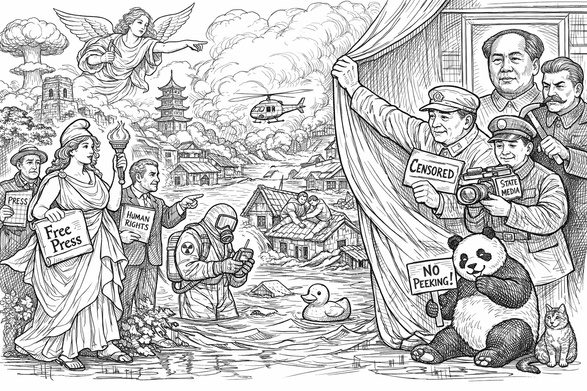
#china#floods#media transparen#government contr#human rights#flooding#disasterresp#extremeweather#climatechange#henan
Leftist
China's ongoing concealment of disaster severity, evidenced by misleading reportage on floods, underscores a critical need for transparency. People's lives are not mere propaganda tools; the state must prioritize human welfare over image management. Historically, censorship has hampered global awareness in crises, similar to USSR's Chernobyl. International accountability mechanisms should be implemented to promote accurate information sharing and uphold human rights.
Rightist
China's opacity in disaster reporting reflects broader issues of government overreach and restrictions on free media, raising concerns about authoritarian governance. This mirrors past instances like during the Soviet era, where state control hindered honest discourse. It's a reminder of the importance of national sovereignty and the risks of centralized power. Calls for transparency should respect China's internal governance while encouraging media freedom for true accountability.
 | author: | Amy Hawkins | institution: | The Guardian | ¿porque no los dos? |
| tl;dr | The Guardian article reports on severe flooding in China and argues that authorities are not fully acknowledging the scale of the disaster. It describes flood impacts (damaged infrastructure, evacuations, and casualties), and includes criticism from analysts/observers about transparency, disaster communication, and preparedness. The piece contrasts official statements with reported local conditions and emphasizes the need for clearer public information and accountability as extreme weather risks rise. | ||||
| deeper: | The reporting is generally strong: it’s timely, uses specific on-the-ground descriptions, and frames the story within broader climate and governance challenges. Bias shows up mainly in emphasis and framing—highlighting state opacity and accountability issues in China more than operational constraints or competing official explanations. The article appears to rely heavily on secondary sources/experts and reported accounts rather than extensive primary data (e.g., detailed hydrology figures, full official response metrics), which slightly limits completeness. | ||||
media: | |||||
| gen: 2026/08/23:21:39 in 2 min 22.3 sec (old)bias: 3 (Center-Left) |
| type: lolsquality: 78 |
| pts: 0 |

 | author: | Amy Hawkins | institution: | The Guardian | ¿porque no los dos? |
| tl;dr | The Guardian reports that Hui Ka Yan, founder of China’s Evergrande, has been sentenced to life in prison after pleading guilty to fraud. The piece says he and others were accused of inflating company finances and that authorities will confiscate his personal property. It places the case in the wider context of China’s real-estate downturn, heavy developer debt, and Beijing’s regulatory crackdown, noting Evergrande’s outsized role in the sector’s broader crisis and household exposure through pre-sold homes. | ||||
| deeper: | The article is largely straight news with clear attribution and context about the property slump and enforcement actions. Bias is modest: language and framing lean toward skepticism of Evergrande’s conduct and highlight systemic risks and government crackdown, but it does not read as polemical. Quality is strong due to coherent narrative, relevant background, and specific figures; it would be higher with more primary-document detail (court judgment text, defense claims, and fuller sourcing beyond official statements/media reports). | ||||
media: | |||||
You made it to the bottom. Now dance!


owned and operated by: RPN Omnigalactic Insitutution as of: 2026/10/15: 04:48 in 0 ms
Enter Code
Login with Account